From 24 September 2026 to 31 January 2027, the Sale Fabiani at Palazzo Medici Riccardi will host Saint Francis of Assisi and Giuseppe Nicola Nasini. An episode of Medici patronage, an exhibition promoted by the Metropolitan City of Florence, organised by Fondazione MUS.E and curated by Riccardo Spinelli, with the patronage of the National Committee for the Celebration of the Eighth Centenary of the Death of Saint Francis of Assisi, the Papal Basilica and Sacro Convento of Saint Francis in Assisi, and the Friars Minor Conventual of the Basilica of Santa Croce in Florence. The exhibition explores the figure of Giuseppe Nicola Nasini, his privileged relationship with the grand-ducal court, and the particular interplay between Medici and Riccardi patronage in late seventeenth-century Florence.
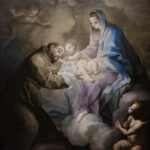
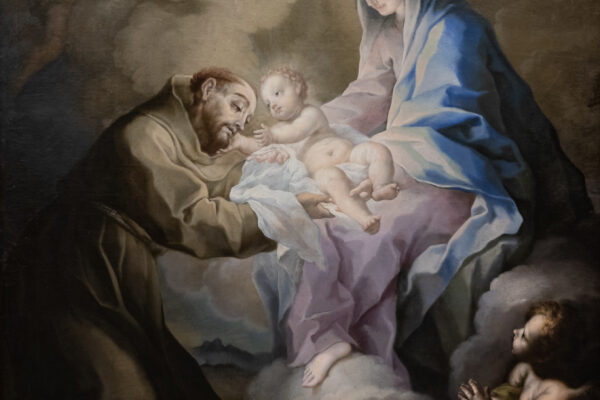
At the heart of the exhibition are the four surviving large canvases from the cycle commissioned in 1695 by the Grand Duke of Tuscany, Cosimo III de’ Medici, from Giuseppe Nicola Nasini: Saint Francis Receives the Stigmata, Saint Francis, Dying, Puts on the Habit, Saint Francis, Dying, Blesses Brother Elias and Vision of Saint Francis in which the Virgin Offers Him the Christ Child. A fifth work, depicting the Miracle of the Thorns and the origin of the “Pardon of Assisi”, is now lost.
The origins of the cycle date back to Cosimo III’s pilgrimage to Assisi in 1695. Hosted by the friars of the Sacro Convento in the quarters reserved for the pope, the Grand Duke received a precious relic when he departed: a fragment of Saint Francis’s hair shirt. On his return to Florence, he commissioned Nasini to paint five canvases intended for the Sacro Convento as a token of gratitude for the welcome he had received. The paintings were sent to Assisi as early as the beginning of January 1696 and installed in the apartment where the sovereign had stayed, in specially made stucco frames financed by Cosimo III himself.
This story is closely intertwined with that of Palazzo Medici Riccardi. At the time the Franciscan canvases were commissioned, the palace no longer belonged to the Medici: it had been purchased by the Riccardi family in 1659 and had become their Florentine residence, undergoing an extensive programme of enlargement and refurbishment in the second half of the seventeenth century. Born in Castel del Piano in 1657, Giuseppe Nicola Nasini trained in Rome and Venice, also thanks to Cosimo III’s direct support. The Grand Duke followed his career closely: after his years at the Medici Academy in Rome and his stay in Venice, in 1689 Nasini was appointed aiutante di camera d’onore, and the following year superintendent of drawings for the Gallery of Florence. The Franciscan commission thus came at the height of the relationship between the painter and his principal Medici patron. At the same time, Nasini’s work for Marquis Francesco Riccardi bears witness to the close relationship between the grand-ducal court and one of the most influential families in Florence at the time. Since acquiring the ancient Medici palace in Via Larga in 1659, the Riccardi family had promoted a major transformation of the building, involving some of the leading artists active in the city and close to the court.
Around the four canvases from the Sacro Convento of Assisi, the exhibition reconstructs the protagonists and context of this story through paintings, portraits, sculptures, medals and documentary evidence. The Franciscan story is introduced by Saint Francis Receiving the Stigmata in Prayer before the Cross by Lodovico Cardi, known as Cigoli, from the Convent of Saint Francis of the Friars Minor of Tuscany. Alongside it are images of Giuseppe Nicola Nasini and several portraits of Cosimo III, allowing the protagonists of the story to be given a face and identity. A particularly significant group consists of the five letters exchanged between Florence and Assisi between January and May 1696, which document almost first-hand the dispatch of the paintings, their arrival at the Sacro Convento, the making of the frames, and the satisfaction expressed by the Franciscans and Cosimo III himself. The documents thus make it possible to reconstruct not only the artistic origins of the cycle, but also the symbolic meaning attributed to the Grand Ducal gift from the outset. The exhibition also presents, in facsimile, the refined preparatory drawing for Saint Francis, Dying, Puts on the Habit, preserved in the Chigi Saracini Collection in Siena, testimony to the care with which Nasini developed the composition before translating it into the large canvas. The works directly connected with the 1695 commission are accompanied by the Reliquary of Saint Francis’s Habit, from the Compagnia delle Stimmate of the Basilica of San Lorenzo. The precious reliquary contains relics of the Saint’s habit donated in 1710 by Cosimo III to the Florentine confraternity, extending the exhibition’s exploration of the relationship between the Grand Duke, Franciscan spirituality and the city of Florence.
The five works commissioned by Cosimo III remained in the Sacro Convento of Assisi for a long time. In the second half of the nineteenth century, following the suppression of religious corporations and the transformation of the convent buildings, they were removed from their original location and placed in storage; at this stage, one of the canvases was lost. The four surviving works, rediscovered through scholarly research and restored from 2017 onwards, were subsequently returned to the Chapter House of the Sacro Convento, a central place in the life of the Franciscan community. Their temporary return to Florence now makes it possible to reassemble the historical context in which they were created and, more than three centuries later, to revisit an emblematic chapter in the patronage of Cosimo III and the career of Giuseppe Nicola Nasini.
The project is accompanied by a catalogue published by Edifir Edizioni Firenze.