Promoted by the Metropolitan City of Florence and organised by Fondazione MUS.E, the exhibition – curated by Daniel Blau, Sergio Risaliti and Valentina Zucchi – brings together a selection of around 150 works, from Georg Baselitz’s private collection and the collections of the Museum of Fine Arts, Budapest. The exhibition allows visitors to explore the techniques, languages and themes developed by the great artists of sixteenth-century Europe – also looking back to the late fifteenth century and forward to the early seventeenth century – with particular attention to the challenges and achievements of printmaking and to the artists who shaped it.
The opening of “Beyond the Renaissance” on 10 September comes just three days before the closing of “Baselitz. AVANTI!”, the major exhibition devoted to the artist by Museo Novecento in Florence until 13 September 2026, offering itself as its natural and valuable complement. The Museo Novecento project spans more than sixty years of the German master’s career through around 170 works, including prints, paintings and sculptures, placing at its centre a fundamental dimension of his research: his graphic and printmaking practice.
This brief but significant overlap offers the public a special opportunity to explore Baselitz’s personality and artistic research from two complementary perspectives. At Museo Novecento, we encounter the artist who made printmaking an autonomous field of experimentation, transformation and continual questioning of the image; at Palazzo Medici Riccardi, we discover instead the collector and connoisseur of the Old Masters, drawn to the inventive freedom, dissonances and unconventional approach of Mannerist printmaking. In the days immediately following the opening of the exhibition at Palazzo Medici Riccardi, visitors will thus be able to create an ideal Florentine itinerary between Baselitz the artist and Baselitz the collector. His precious collection is complemented by a number of selected masterpieces from the Museum of Fine Arts, Budapest, which, like cameos, accompany and enhance the exhibition narrative with rare refinement and distinction. The project at Palazzo Medici Riccardi takes its starting point from the important exhibition “The Mannerist Mind. Prints from the Georg Baselitz Collection”, presented between late 2025 and early 2026 in the galleries of the Museum of Fine Arts, Budapest, with a selection of Mannerist prints belonging to the Hungarian museum’s collections and to the German artist’s collection. The Florentine exhibition offers a new interpretation of it, constructed around the dialogue between sixteenth-century works and the sensibility of one of the leading figures in contemporary art. The prints are also accompanied by four important sculptures by Baselitz, which seem to mark the journey into the world of Mannerist printmaking, highlighting its connections with the contemporary world, as well as by his eloquent self-portrait.
Baselitz was not only a radical and innovative artist, but also a highly significant collector. His collection of prints by the Old Masters grew out of an interest that emerged as early as the 1960s and developed continuously over more than six decades. The artist’s curiosity was joined by the eye of a connoisseur, giving rise to a body of works of great value, capable of revealing his affinities, preferences and the questions that accompanied his artistic research.
The relationship between Baselitz and the Museum of Fine Arts, Budapest has strengthened over time: in 2017 the museum devoted a solo exhibition to him and, three years later, the artist donated thirty prints to the Hungarian collections. The Florentine exhibition develops this dialogue and brings together two different forms of collecting – that of a public institution and the private collection of an artist – inviting reflection on the very idea of a collection as an impulse to preserve, safeguard, study and share works of art.
At the heart of the exhibition is precisely graphic production, understood not as a secondary field in relation to painting, but as a privileged terrain for research and experimentation, as well as for extraordinary formal expression. Just as artists of the past used drawings and prints as repositories of images, models and sources of inspiration, so Baselitz has amassed throughout his life a remarkably rich graphic heritage, bringing together the achievements of Italian, French, German and Flemish masters and offering an exceptional insight into what artists sought, experimented with and achieved through printmaking techniques.
The history of Baselitz’s Mannerist collection has, moreover, a significant starting point: the acquisition, in 1964, of “The Sacrifice” by Antonio Fantuzzi da Trento, which reproduces and interprets Rosso Fiorentino’s painting at Fontainebleau. From that moment onwards, the artist continued to expand his collection, drawn by the unconventional approach, inventive freedom and extraordinary figuration of prints from the period. In the unstable and eccentric forms of Mannerism, Baselitz recognised a possibility of transcending the norm and questioning the classical vision.
The exhibition therefore presents works by innovative Italian artists of the late fifteenth century and the Mannerist period, including Andrea Mantegna, Parmigianino and Andrea Schiavone; the French printmaking masters of the School of Fontainebleau, such as Léon Davent, Geoffroy Dumonstier and Juste de Juste; Dutch and German artists such as Albrecht Dürer and Hans Sebald Beham; and some of the foremost experimenters in chiaroscuro printmaking, from Ugo da Carpi to Domenico Beccafumi, from Andrea Andreani to Hendrick Goltzius. These are joined by selected masterpieces from the Budapest collections, including works by Antonio del Pollaiolo and Parmigianino himself.
The various woodcuts, including those made from multiple blocks, etchings, engravings and drypoints document the many possibilities offered by printmaking techniques, demonstrating how they can produce markedly different effects, at times linear, chiaroscuro or tonal. The working of the blocks and plates, the skill involved in executing the marks, the variations introduced during the printing processes and the infinite possibilities of rendering become expressive tools through which sixteenth-century artists put tradition to the test and construct not only new images, but also a new vision, circulating throughout Europe and thereby fostering exchanges between different sensibilities, models and experiences.
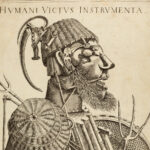
The exhibition unfolds through time and space: starting with Albrecht Dürer’s celebrated prints, including the famous Rhinoceros, it presents a substantial series of works by Lucas Cranach the Elder, in dialogue with one of his rare woodblocks; these are followed by the marvellous chiaroscuro prints of Domenico Beccafumi and Ugo da Carpi, including the famous and powerful Diogenes, before giving way to the inventive and accomplished Jacques Bellange. The exhibition continues with a series of prints derived from a lost painting by Arcimboldo, one of which has become an icon of the exhibition, and with fanciful costume figures, before turning special attention to the work of Parmigianino and his circle around Raphael’s oeuvre and the iconographic theme of the Entombment of Christ. Solitary figures, whether meditating, posed in heroic attitudes or rendered monumentally, punctuate the final galleries in counterpoint to the works of artists of the School of Fontainebleau, bringing the exhibition to a close – in homage to our Renaissance – with the pioneering works of Antonio Pollaiolo and Andrea Mantegna.
The exhibition is based on the show “The Mannerist Mind. Prints from the Georg Baselitz Collection”, curated by Daniel Blau and Eszter Kardos and organized by the Museum of Fine Arts, Budapest, 11 December 2025 – 15 March 2026.